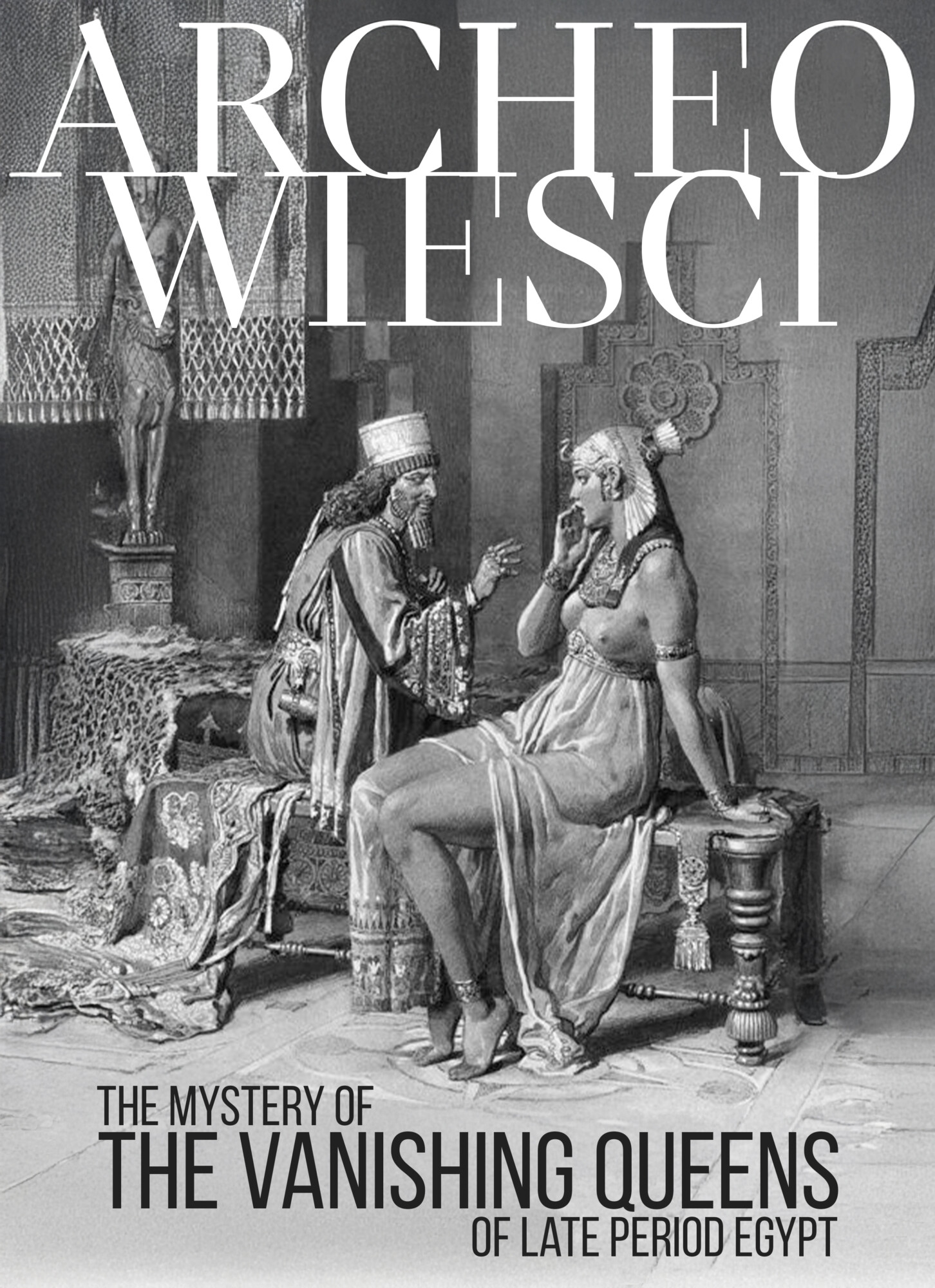
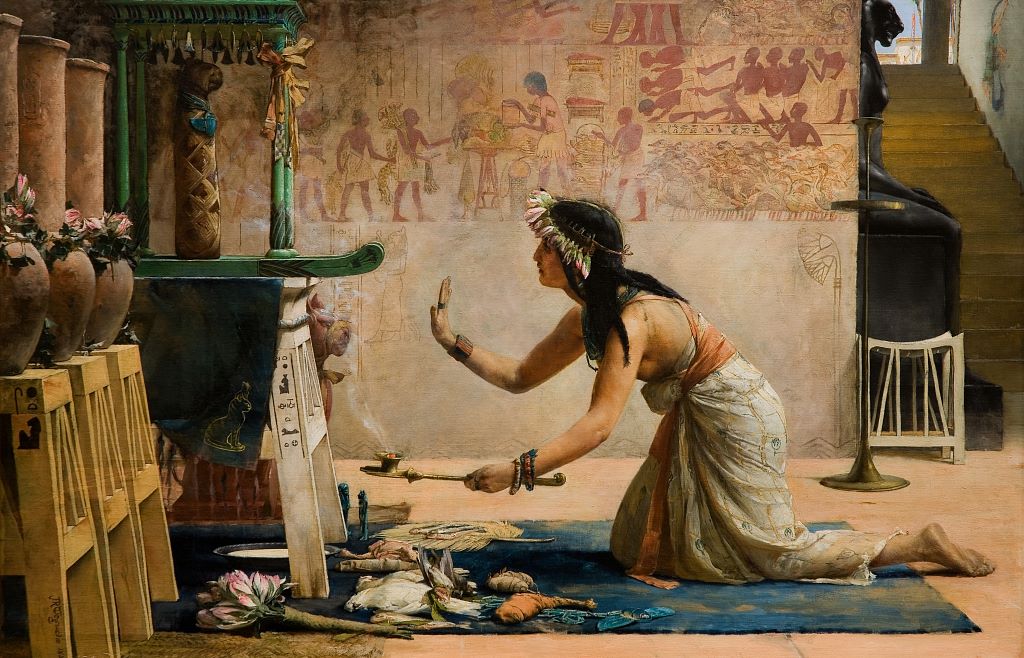
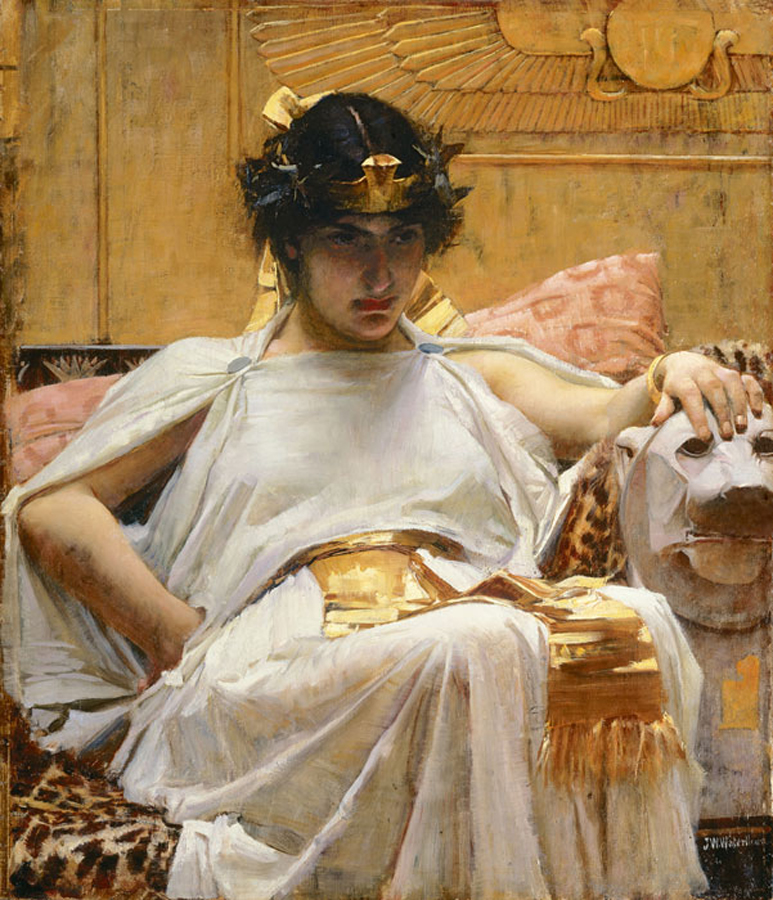
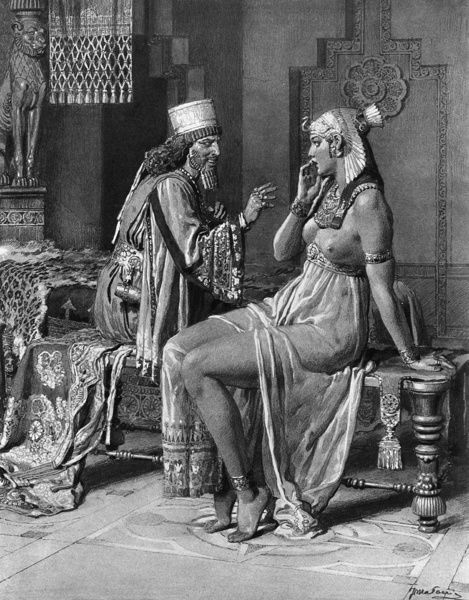
Queens of ancient Egypt – these words stimulate the imagination, evoking images of exotic women dressed in exquisite robes and accompanying pharaohs in elaborate temple rituals. We owe these visions, at least in part, to 19th-century painters such as John Reinhard Weguelin (1849–1927) and Frederick Arthur Bridgman (1847–1928), who popularized Orientalist images of ancient Egyptian women.
The artistic illusion of splendor
The representations created by 19th-century Western artists, however, often have little to do with the image created by the actual evidence of past eras that archeological data gives us. Though almost everyone has heard of Cleopatra or Nefertiti, in reality – with the exception of (mainly popular science) biographies of these famous figures – few scientific works have been written about Egyptian women from the royal family or the phenomenon of “being a queen” in Ancient Egypt.
Public domain
One of the most puzzling phenomena related to the feminine aspect of royal power is the almost complete disappearance of women belonging to the ruling family (queens, princesses, royal mothers) from the iconography of Egyptian temples and tombs, and even sculptures in the Late Period (c. 747–332 BC) – the era preceding Alexander the Great’s arrival in Egypt. Interestingly, under Greek rule, images of queens “returned” to their place in art. What was the reason for this sudden disappearance, and what caused the depictions of royal women to return to the spotlight?
The Great Absentees
The Late Period (c. 747–332 BC, in terms of the Dynastic timeline: from the 25th to the so-called “31st” dynasty) was a time when armies of empires such as Kush, Assyria, and Persia marched through the Nile Valley, and control of Egypt passed successively into the hands of foreign rulers. Each period of foreign domination left its mark on Egypt, and the history of this era is written in many languages.
Despite the existence of numerous studies on the political history, wars, and dynastic changes of this period, what is striking is the relatively little focus on women of the royal family. This refers to both the rulers’ wives and other women who in earlier times played an important role in the ideology of power and its actual dimension: primarily royal mothers, who often enjoyed great influence at court, as well as royal daughters. The only representatives of the royal family (or “royal families,” as representatives of many unrelated families sat on the throne of Egypt at that time) well attested in the source material are the so-called Divine (Divine) Wives of Amun – priestesses chosen from among princesses, residing in Thebes and enjoying numerous privileges previously reserved for the rulers themselves.
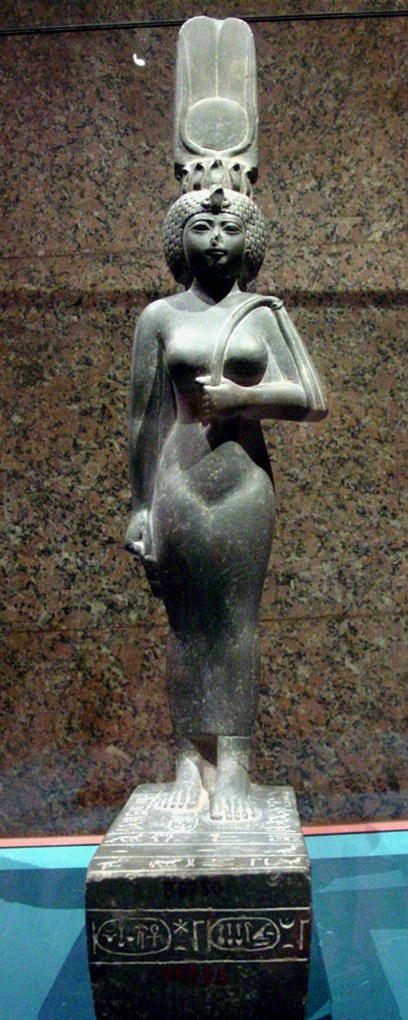
Statue of Anchenesneferibry, Divine Wife of Amun
© J. Campana, licensed under CC BY 2.0
The relatively modest state of the sources was interpreted by researchers as reflecting the limited role of women in the royal family during this period.
“The lack of source material on the role of the new queens of Egypt means that once again we are faced with a faceless list of names,” writes British researcher Joyce Tyldesley about the women of the 25th dynasty.
“Because the Egyptian dynasties were either non-existent or weakened, there was no strong monarchy that needed female protection. (…) Without unyielding authoritarianism, the women of the royal family were, ironically, just as devoid of masculinity,” echoes American Egyptologist Kara Cooney.
The validity of this opinion seems to be confirmed by another phenomenon – the alleged lack of depictions of Egyptian queens in Late Period art.
Where have their images (and flowers) gone?
It began with Bernard V. Bothmer (1912–1993), an eminent expert on ancient Egyptian art. In the catalog of an exhibition on Late Period sculpture organized in the early 1960s by the Brooklyn Museum, Bothmer included four short sentences that would dominate the perception of women in the art of that era for decades to come.
“During the 25th Dynasty,” Bothmer claimed, “the practice of carving stone sculptures of queens and women outside the royal family ceased altogether; the only women depicted in this manner were princesses serving as divine spouses of the god Amun. At the end of the 26th dynasty, we find several stone likenesses of women from the private sphere, and even during the reign of Necho II, women appear in group statues. Later, for centuries until the arrival of Alexander the Great, no woman was granted this honor (…) The reason for this bizarre taboo (…) remains unknown.”
The words of Bothmer, an unrivaled authority in his field, had a huge impact on the next generations of researchers and reinforced the view that in the Late Period in Egypt. No sculptures depicting women were created – despite the fact that statues such as the granite likeness of Tasheritniset, mother of Pharaoh Amasis (who reigned from 570 to 526 BC), currently housed in the British Museum (EA 775), or the fragment of a limestone statue of the Kushan queen Chensa found in Karnak by Henri Chevrier (1897–1974), were already known at the time of the publication of Bothmer’s catalog.
The real problem, however, is that a significant number of known depictions of women shown with royal insignia from this period do not have inscriptions identifying the person portrayed. These women are therefore completely anonymous to us. Given the claim that there was a supposed taboo on the production of female statues in the Late Period, these nameless sculptures are now usually classified as images of goddesses personifying the female aspects of the monarchy. Interestingly, the same artistic tendency to create anonymous images also persists in the Ptolemaic era. However, during this period, this trend applies to both queens and rulers – hence the identification of so many representations of the Ptolemies, including the famous Cleopatra VII, remains ambiguous. In the case of later sculptures, however, it is rarely accepted that a given statue depicts a deity rather than a historical figure, which in itself testifies to an inconsistent approach to this problem in relation to different eras.
Public domain
A similar research problem arises in relation to the alleged absence of women from the royal family in the wall decorations of Egyptian buildings. Reliefs and paintings depicting Egyptian queens and princesses are known from earlier periods; their absence in the Late Period may indeed seem striking at first glance. Among the hypotheses explaining this state of affairs are arguments that, over time, the iconography of women from the royal family and goddesses became so similar that the goddesses “took over” the role of the former, replacing them in scenes where representatives of royal families had previously appeared. However, is there another, simpler solution to this problem?
The vast majority of depictions of Egyptian queens and princesses found on the walls of Egyptian buildings come from their tombs. In the Late Period, members of the Kushite (25th dynasty) and Persian (27th and so-called “31st” dynasty) ruling families were buried in their homelands. Given the practice of depicting the deceased on the walls of tombs, this means that we are deprived of the most important source of Egyptian depictions of these women. On the other hand, members of the indigenous dynasties (26th and 28th-30th dynasties), with some exceptions, were buried in Lower Egypt, where, among other things, unfavorable geological conditions (not to mention soil conditions and their impact on the preservation of remains) mean that the condition of such structures is much worse than that of similar monuments in the south of the country. For example, in the case of the untouched burial of Tachut, the royal wife of Psamtik II (reigned 595–589 BC), discovered in Athribis, only the queen’s burial chamber has survived to the present day. During the Greco-Roman period, a bathhouse was built above its ceiling, effectively depriving us of the possibility of reconstructing the above-ground part of the tomb.
In the context of temples and the absence of female representations on their walls, the situation also turns out to be more complicated. It is known that the queens of the 25th dynasty appear in the decoration of temples in their homeland, but not only there! An unnamed royal consort is depicted on the wall of the poorly preserved Temple A in the cult district of the goddess Mut in Karnak, Egypt.
However, in the case of temples founded by the rulers of the indigenous dynasties of the Late Period, the main problem is caused by the geological conditions mentioned above. The vast majority of these buildings were erected in the Nile Delta, which means that only fragments of the temple decorations have survived. Therefore, we cannot rule out that women were originally part of it, but we are also unable to confirm this. It is worth noting that frequent changes on the throne meant that even in the case of the pharaohs of this period, iconographic material is extremely scarce. Suffice it to say that at this point we do not have a single representation (not only from the building decoration program, but in general) of rulers such as Amyrtaios (reigning in 404–399 BC), Psammuthis (probably 393 BC), or Teos (365–360 BC), and in the case of the former, even the hieroglyphic spelling of his name is unknown. Such is the fate of those who ruled for a short time.
Finally, the construction activities of the Persian rulers of Egypt are relatively well documented, and indeed, women from the ruling family do not appear in the iconographic program of their temples. However, it should be remembered that in Achaemenid art, images of women appear only on objects such as seals or plaques, but not in the decoration of buildings. For example, in the palace of Darius I in Persepolis, there is not a single depiction of a woman from the royal family. Perhaps, therefore, the absence of Persian queens in the iconography of Egyptian temples reflects a tradition originating outside Egypt, rather than their deliberate exclusion or low status at court.
Not only the names
Can we therefore say that women from the royal family ceased to play any role at court in the Late Period? Are we really dealing with nothing more than a list of names, the owners of which are unknown?
The answer to this question is certainly not. Analysis of the available sources allows us to establish a great deal of information about various aspects of the activities of women from the royal family during this period. It is known that foreign queens of Egypt, both those from Kush and Persia, visited the country on the Nile, and some of them even moved their courts to Egypt.
Kushite and Egyptian queens played an important role in the cult of Egyptian deities, funded statues, and rewarded dignitaries; their names were inscribed in oval frames called cartouches, and long titles were formulated for them. According to classical authors, the Egyptian princess Nitetis was to become the cause of Cambyses II’s invasion of Egypt, while the Persian queen mother Amestris was allegedly directly responsible for the execution of the Egyptian prince Inaros. The recently discovered seal impression of Queen Chensa from Hosh el-Geruf has allowed its discoverers to hypothesize about her influence in the economic sphere as well. We know that royal daughters could be educated on an equal par with their brothers, and we even know the names of their nannies and teachers. Finally, the burials of women from the ruling family are also known. In addition to the already mentioned intact tomb of Queen Tachut, it is worth mentioning the well-preserved, decorated burial chapel of the wife of Psamtik I (reigned 664-610 BC), Mehytemusechet, built next to the tomb of her daughter, the Divine Wife of Amun Nitocris, in Western Thebes. It is also known that the queens of the Late Period were the subject of posthumous worship.
Public domain
All this makes the judgment regarding the marginal role played by women of the royal family in the Late Period seem premature and inaccurate. Although the number of preserved sources remains unsatisfactory, it is not as insignificant as is often suggested. The image of Egyptian queens of this era as “great absentees” seems to be more a result of previously accepted research assumptions and a lack of broad interest in the subject than a true reflection of the socio-political situation at the time.
Author: Marta Kaczanowicz
https://orcid.org/0000-0003-4477-9207
https://uw.academia.edu/MartaKaczanowicz
Editing and translation: A.B.
The text was written as part of the funding for the project “Campaign promoting research by the Faculty of Archaeology of the University of Warsaw in the Nile Valley” from the Initiative of Excellence – Research University program (IDUB)