Archaeological research conducted since the 1960s in western Mazovia, PL, has shown that this region was once far more than merely a tranquil inland area. It was here that at the dawn of Antiquity a vast iron-production centre operated, today known as the Mazovian Center of Metallurgy. The scale of metallurgical activity carried out in Mazovia was truly remarkable. Iron production, however, was not the only pillar of the economy at that time.
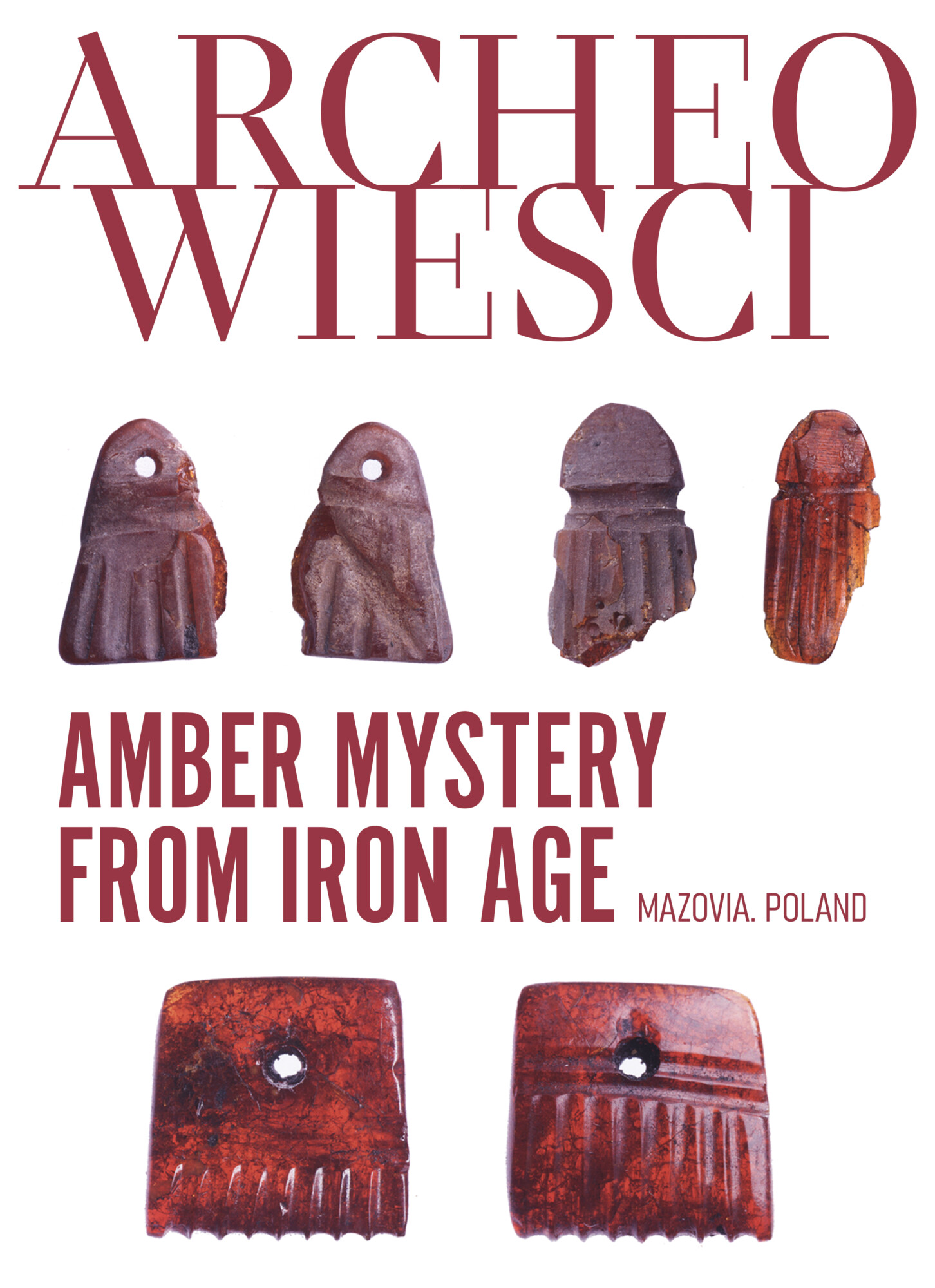
Alongside the relics of metallurgical craft, archaeologists discovered something much more surprising. The remains of… amber workshops! And no, these were not just some isolated finds, but entire production complexes! Finished ornaments, raw lumps, production waste – all of them show that amberworking in Mazovia was carried out on a truly massive scale. However, these finds generate more questions than answers. There are no natural amber deposits in this area. There is also no data indicating its strong cultural exploitation in this region.
So where did it come from and why did it appear here?
Prof. Adam Cieśliński from the Faculty of Archaeology of the University of Warsaw and Dr Marcin Woźniak from the Museum of Ancient Masovian Metallurgy in Pruszków are trying to answer these questions. They presented some of their latest findings in the publication ‘Amber workshops in central Poland during the Roman Period’. Below you will find a short overview!
You can read this article in 12 minutes!
Przeworsk Culture
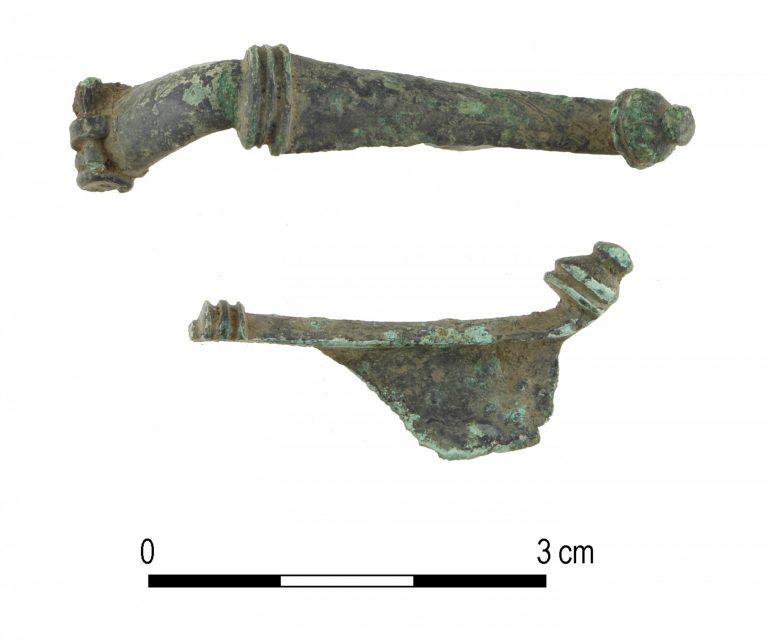
From the 2nd century BCE to the mid-5th century CE, a large part of the territory of present-day Poland was inhabited by the population of the so-called Przeworsk culture, one of the most important archaeological units of prehistoric Central Europe. Archaeologists distinguish it mainly on the basis of their characteristic products of material culture and burial customs, among which cremation dominated, along with the frequent furnishing of male graves with weapons and local forms of ornaments and dress accessories made mainly of iron.
© M. Woźniak, under license CC BY SA 4.0
Based on such features, one might get the impression that this was a community focused mainly on warfare. In reality, however – as Prof. Bartosz Kontny from the Faculty of Archaeology of the University of Warsaw has explained in an issue of Archeologia Żywa – it was a group well adapted to the environment in which it functioned. Settlements were most often established near rivers, on flood terraces, where easy access to water, wood and fertile soils was combined with the presence of bog iron ores, the basic raw material for iron production. At the same time, rivers also served as natural communication routes, and the landscape provided everything needed for everyday life and craft production.
In this environment, agriculture based on small communities developed. At its heart were cereals resistant to more difficult conditions, such as rye, millet and oats. Animal husbandry also functioned in parallel, dominated by cattle. Their diet, in turn, although varied, was largely based on dairy products and cooked dishes. Meat remained a rather occasional luxury.
And it was precisely in this seemingly quite simple world that an extensive network of Przeworsk crafts functioned. From pottery and weaving, through the working of bone and antler, to blacksmithing and the production of iron in bloomery furnaces. The main products were, of course, objects of everyday use, tools and weapons. Some regions, however, specialised in production that exceeded local needs. It is against this background that Mazovia stands out today in a particularly surprising way.
Archaeological research carried out since the 1960s has revealed here the existence of one of the largest centres of iron production in barbarian Europe, now known as the Masovian Centre of Metallurgy.
A few words about the Masovian Center of Metallurgy
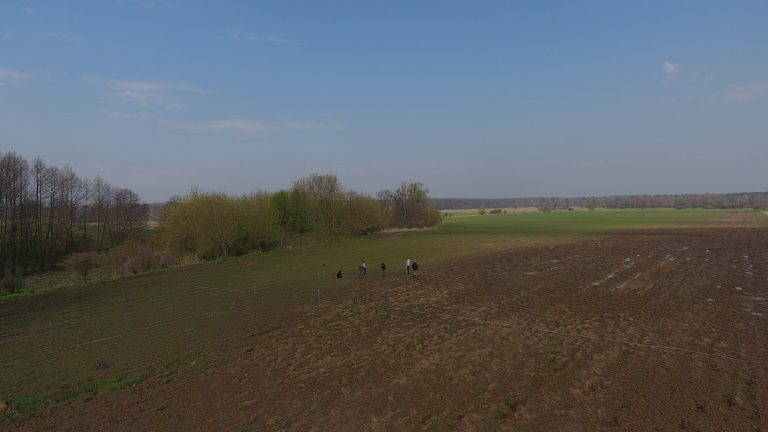
The term ‘Masovian Center of Metallurgy’ as stated by the Stefan Woyda Museum of Ancient Masovian Metallurgy in Pruszków, refers to a group of around 240 archaeological sites discovered in western Mazovia, dominated by settlements with traces of clearly mass-scale iron production.
© A. Tomas, under licenseCC BY SA 4.0
The most important among them are large, long-lasting residential and economic settlements with clearly separated production zones, where activities connected with iron extraction, through smelting, were carried out. Alongside them, there were also smaller, short-lived settlements, rather loosely connected with metallurgy. And a dozen or so cemeteries. But today is not about them!
Today is about amber from the Masovian Center of Metallurgy!
But before we get to it, let us first say a little about metallurgy.
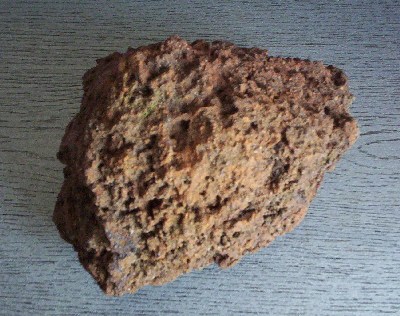
According to researchers, the peak of activity of the Mazovian Centre of Metallurgy fell in the 1st and 2nd centuries CE. The basis of its activity was locally available bog iron ore. Iron was smelted from it in single-use (!) bloomery furnaces, the remains of which today allow the scale of production to be assessed relatively precisely. Some sites had a handful of furnaces, but at the largest sites, traces of tens of THOUSANDS of these furnaces have been discovered. The total number of smelting events is estimated to have been as many as 120 000–150 000…
What does this mean, you may well ask?
– In the first instance, it means that production in the Mazovian Centre of Metallurgy reached a level far exceeding local demand.
But let us go further!
© T. Kuran, under license CC BY-SA 3.0
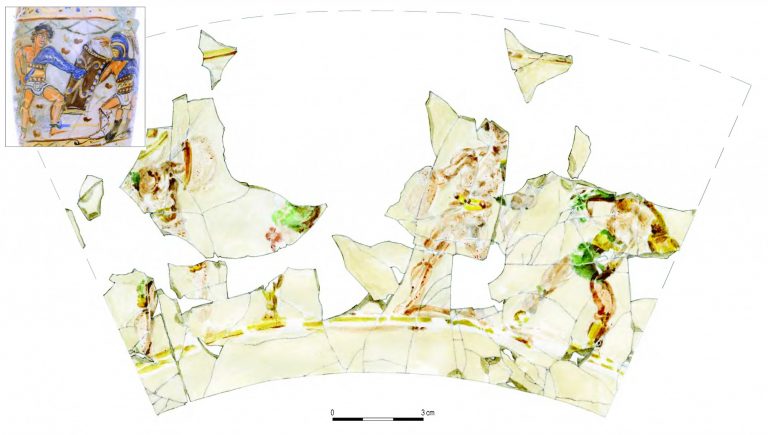
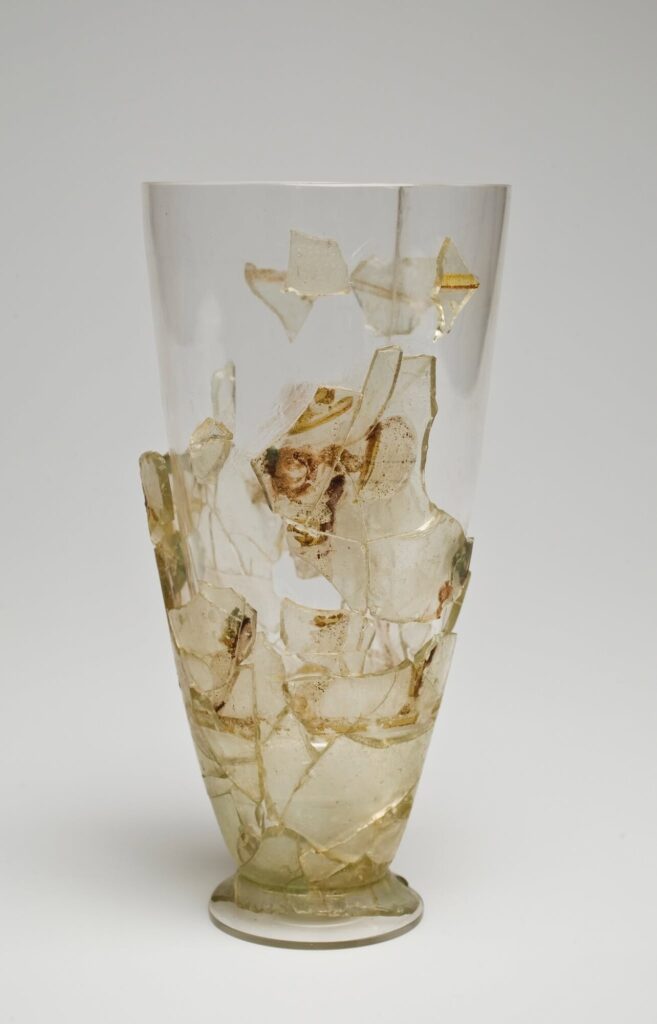
All these discoveries also suggest that a much broader distribution and trade exchange network must have existed in this area. Its effect may have been inter alia the clear economic development of this region, visible, for example, in finds of luxury goods. One of the most famous is a glass cup imported from the Roman Empire, discovered in Zaborów, with depictions of fighting gladiators.
Rys. P. Holub, All rights reserved
So it is precisely in this context that another element appears, one that even more clearly emphasises the significance of this centre. A M B E R, bernstein, jantar, elektron, sun stone, gold of the north. Call it what you will.
In any case, a piece, or rather thousands of pieces, of fossil resin with precious, almost symbolic significance.
© M. Dąbski & M. Bogacki
Source: Facebook page of the archaeological research in Zaborów.
On Przeworsk amber that did not end up in Mazovia by chance
If, dear Reader, you have already digested this subheading with all its semantic baggage, then in principle you do not have to move on to the next part of this text. We encourage you, however, to continue reading, as the details are simply fascinating!
Large-scale archaeological research carried out in Mazovia for more than 50 years has revealed that the production here was much more diverse than previously thought.
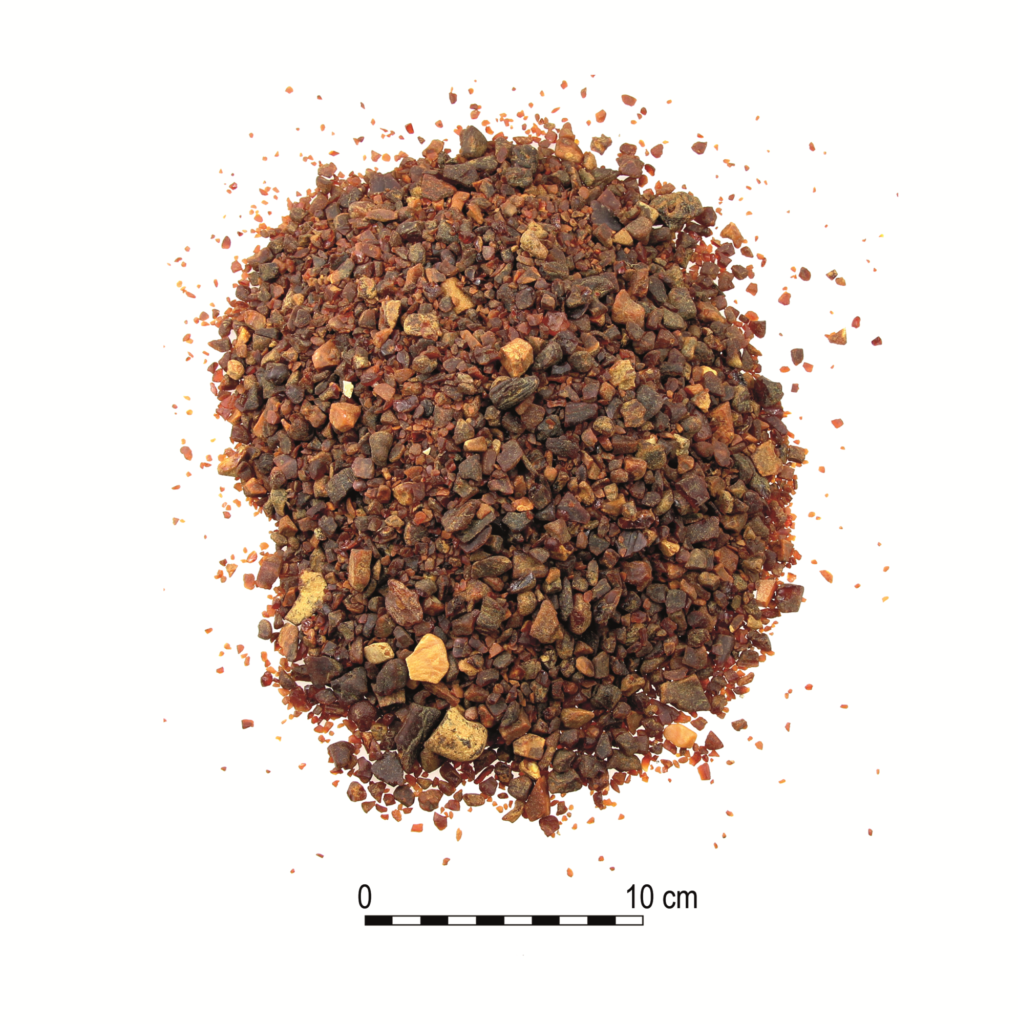
One of the most surprising discoveries turned out to be the remains of amber workshops. Amber finds numbering more than 20 000 items were identified in five settlements of the Przeworsk culture located near to the modern towns and villages Biskupice, Izdebno Kościelne, Regów, Tłuste and Wierzbin.
© M. Woźniak, all rights reserved
What is important is that we are not dealing here with accidental finds, emphasises Prof. Adam Cieśliński.
He adds that clear traces of the full production process were discovered at the sites: from lumps of raw amber, through waste and semi-finished products, to finished objects, primarily beads and pendants. All these discovered in features with various functions, with the vast majority concentrated in several partially sunken buildings interpreted as workshops.
It is precisely in these workshops that the most ‘productive’ dimension of this Masovian amber phenomenon is visible, adds Dr Marcin Woźniak.
Some features contained only scattered concentrations of raw material, while in others clearly separated working zones were visible, where failed or damaged ornaments were found alongside lumps of raw amber. In just one of the workshops, more than 20,000 amber pieces were discovered, clearly indicating that intensive and multi-stage production was being carried out on site.
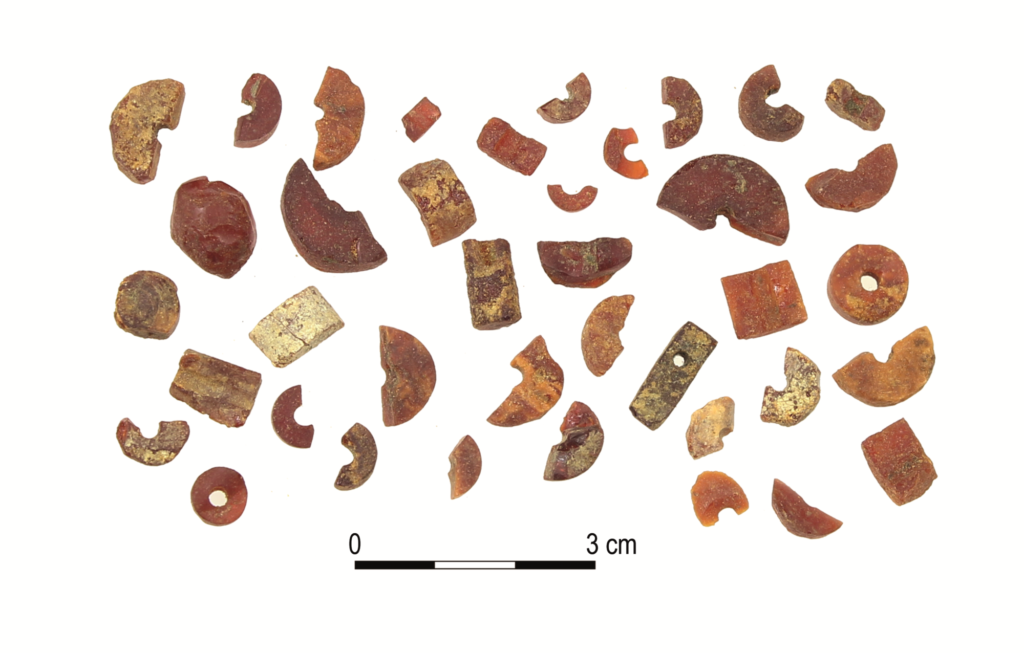
© M. Woźniak, all rights reserved
This amberworking activity was also supplemented by smaller workshops, in which – although the amount of material was definitely smaller – remains of all phases of processing were also present. Although in several cases only single lumps and semi-finished products were identified, their presence only confirms earlier observations concerning the local processing of the raw material.
This latest analytical work therefore reveals a completely new image of Przeworsk Culture Mazovia, which ceases to be solely a metallurgical centre. Instead, it seems that alongside the mass production of iron, this region also had a specialised, well-organised sector for amber processing. A raw material that, in principle, should not have been here… and yet its traces are everywhere!
So where did the amber come from and why did it appear here?
We now move towards closing the narrative circle, by returning to the two main questions raised at the beginning, thus following in the footsteps of the researchers from Warsaw and Pruszków: a) where did the amber come from; and b) why did it appear in the Mazovian Centre of Metallurgy?
In the light of the latest findings, it is most likely that despite some local outcrops of amber in northern Mazovia (including the famous amber-rich Kurpie region), this raw material arrived here from the distant shores of the Baltic Sea, most probably from Sambia and the area of the Gulf of Gdańsk, where the deposits were, and still are, both the richest and the finest. From the very early ages, then, it was a migrating commodity, only ever destined for export.
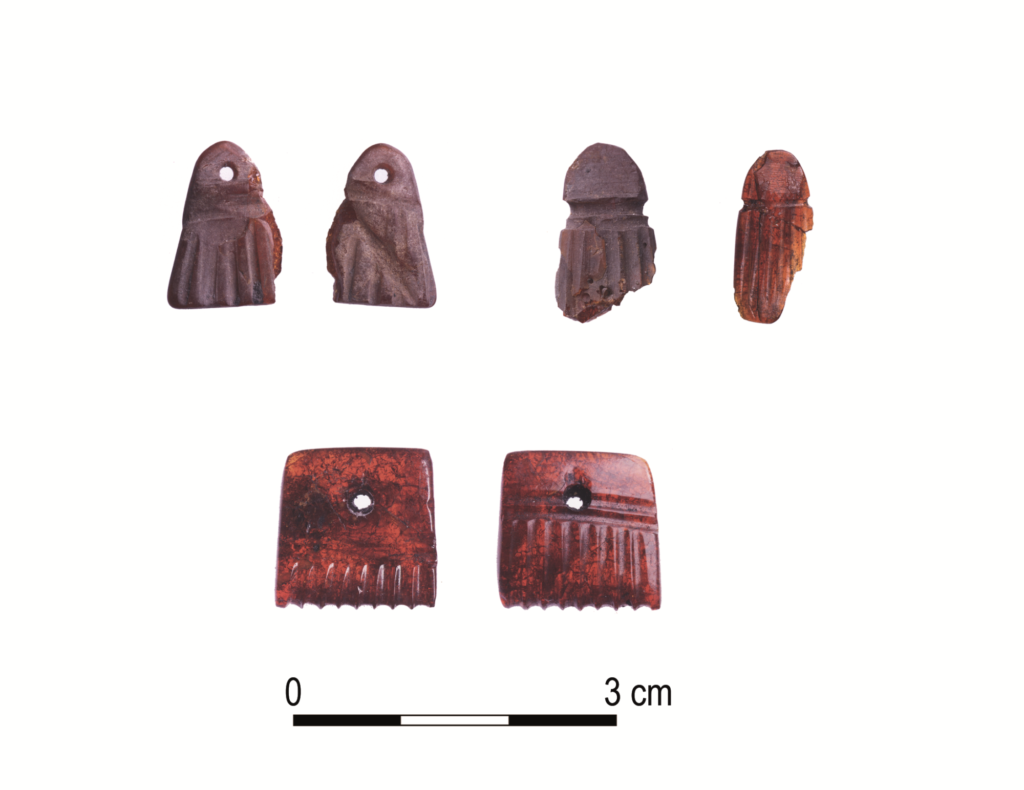
Source: Facebook page of the archaeological research in Zaborów
As Dr Marcin Woźniak emphasises, however, the most interesting thing in this case is not the origin of the amber itself, but the fact that the amber appears here, in a place that was one of the largest centres of iron production in Barbaricum. Was it therefore the iron trade that attracted it here? Or did it perhaps travel along its own, independent routes?
The matter is not so simple. Prof. Cieśliński told Archeowieści that the chronology of the sites suggests the amber and iron did not always ‘meet’. He stressed that most of the dated amber workshops come from the Late Roman Period (3rd–4th century CE), while the metallurgical centre is generally associated with the Early Roman Period (1st–2nd century CE).
It is precisely this specific aspect that both researchers consider to be the most interesting part of the amber mystery. Because, in light of the findings presented here, should the name of this region be changed to the Masovian Amberworking Centre? At least for the 3rd and 4th centuries CE?
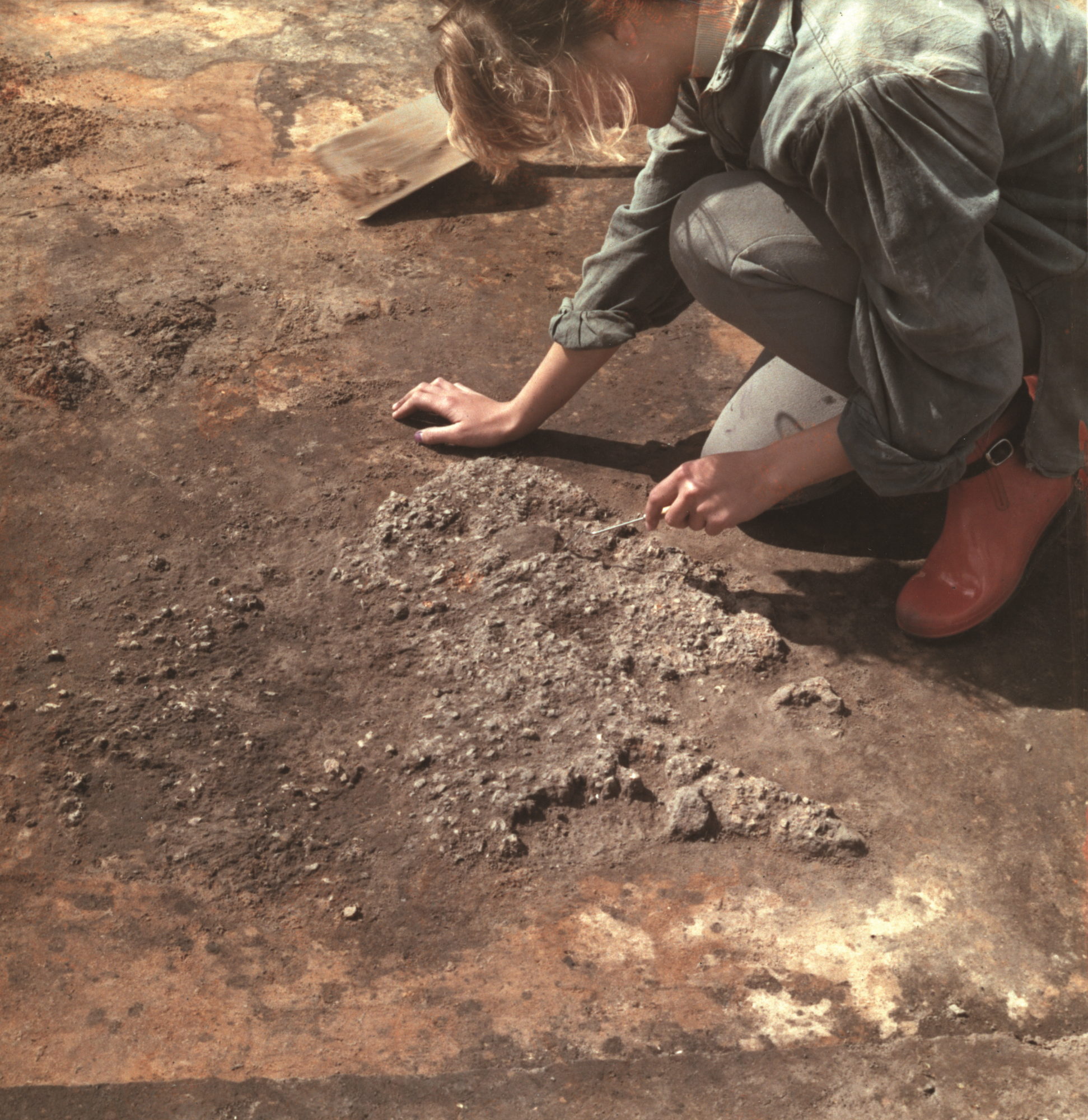
© Archives of the Museum of Ancient Mazovian Metallurgy in Pruszków
Source: Facebook page of the archaeological research in Zaborów
As is usually the case, it is hard to say. Further research will certainly bring new discoveries. What has been found so far, however, is already changing our perception of the use of amber in this period.
As Przemysław Dulęba and Joanna Ewa Markiewicz state in a study also recently published in the journal Praehistorische Zeitschrift, the popularity of amber in northern Europe, whose sea coasts were, after all, full of the stuff, paradoxically declined in the Roman Period. To such an extent that – as the Roman historian Tacitus wrote in Germania, around 98 CE – interest in amber was so low among the local communities of the Aesti that it was extracted by them only on special order from the south.
The discovery of major workshops in Mazovia dated to the 3rd and 4th centuries CE is already changing our perspective on this historical statement. Unfortunately, only more in-depth chronological studies will show how much.
We encourage you to follow the profiles popularising knowledge about these archaeological discoveries in Zaborów, and beyond!
Author: Aleksandra Cetwińska
Translation: J.C.
Proofreading: S.A.
Expert comments:
Prof. Adam Cieśliński (University of Warsaw)
Dr Marcin Woźniak (Museum of Ancient Masovian Metallurgy in Pruszków)
Based on:
Cieśliński, A., Woźniak, M. (2025). Amber workshops in central Poland during the Roman Period. In: Røstad, I.M., Kristoffersen, E.S., Reiersen, H., Pedersen, U., Amundsen, M.D. and Oehrl, S. (eds.) Technologies – Knowledges – Sustainability. Crafting societies in the first millennium CE. Proceedings of the 74th International Sachsensymposion in Stavanger. Norway. Stavanger.
Further reading:
Dulęba, P. and Markiewicz, J.E. (2023). The lords of the Amber Road: amber storage, distribution and processing in the early Iron Age and the La Tène period. Praehistorische Zeitschrift, 98/1, 310–337.
Kontny, B. (2020). Iron Men, czyli o ludności kultury przeworskiej, część I i II. Archeologia Żywa.
Some of the illustrations presented here come from our earlier article in PL:
https://archeowiesci.pl/relikty-przeszlosci-z-poznej-starozytnosci-i-sredniowiecza-pod-warszawa/