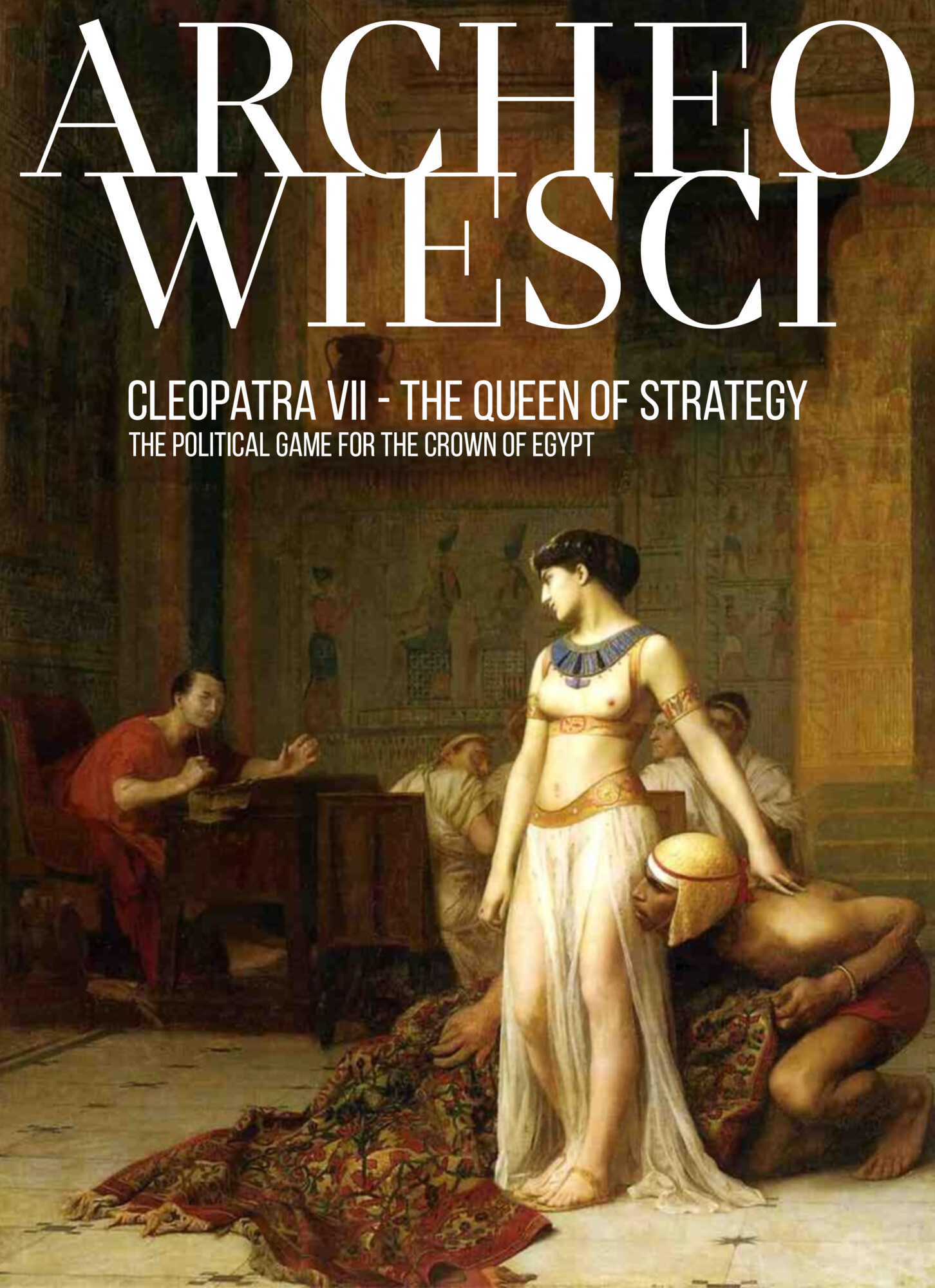
In the history of Ancient Egypt, Cleopatra VII Philopator holds a special place. Not only as the last ruler of the Hellenistic Ptolemaic dynasty, but also as a vital political actor who, in the turbulent final years of Egypt’s independence, skillfully leveraged her assets in the struggle for power against the most powerful empire of the time: Rome.
The choice of this remarkable figure as the central character of today’s story stems from a desire to examine female agency in the sphere of power, far removed from stereotypes and romanticized myths. Cleopatra was not merely the lover of Gaius Julius Caesar or the partner of Mark Antony. Above all, she was a queen, a strategist, and the last hope for preserving Egypt’s sovereignty.
Her actions, both political and diplomatic, were aimed at maintaining authority and ensuring the continuity of the dynasty she represented.
The Legacy of the Ptolemaic Dynasty and the Need for Continuity
The Ptolemaic dynasty ruled Egypt from the time of Alexander the Great’s conquests, with its members maintaining power for nearly three centuries as a Greek-Macedonian elite within the Egyptian state. Although successive generations of Ptolemies gradually lost control over the peripheries of the kingdom, and internal dynastic conflicts weakened the structures of power, the dynasty itself retained stable authority in Egypt.
Cleopatra VII was one of the few members of the family who demonstrated genuine political talent. She also possessed a range of skills that enabled her to conduct effective governance. She knew the Egyptian language, understood the symbolism of local religion, and was capable of pursuing an independent policy, fully aware of both internal dynamics and external threats. Furthermore, her prominence and status are attested by the fact that she issued her own coinage, minted with her image in Alexandria between 51 and 30 BCE. Her actions can be interpreted as an effort to preserve the continuity of the dynasty—not merely symbolically, but concretely, by securing the position of her son, Ptolemy XV Caesarion.
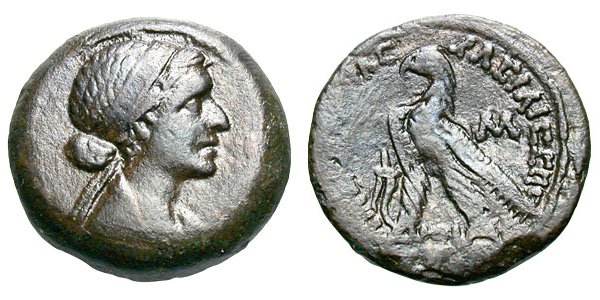
Art Institute Chicago, Public Domain.
Egypt and Rome – An Unstable Dependence
In Cleopatra’s time, Egypt was not yet a Roman province, though its independence was already significantly constrained. Since the interventions of Pompey and Caesar in Egypt’s dynastic affairs, Rome’s role as an arbiter of power had grown increasingly strong. However, Egypt was more than just an exotic kingdom for the Romans—it was a strategic economic asset, primarily due to its grain exports.
It is worth noting that grain production was Egypt’s main strength, not only because of the favorable climatic conditions, but also due to the seasonal, predictable flooding of the Nile. This regularity was key to Egypt’s economic success, based on agricultural production and export. For this reason, control over the delicate political balance in the Nile Delta was crucial for Italy’s food security.
Cleopatra was fully aware of this and skillfully leveraged this knowledge in her political strategy. Her relationship with Gaius Julius Caesar was therefore not merely a romance, but primarily a political alliance. With Caesar’s support, Cleopatra regained the throne, ousting her brother and co-ruler Ptolemy XIII.
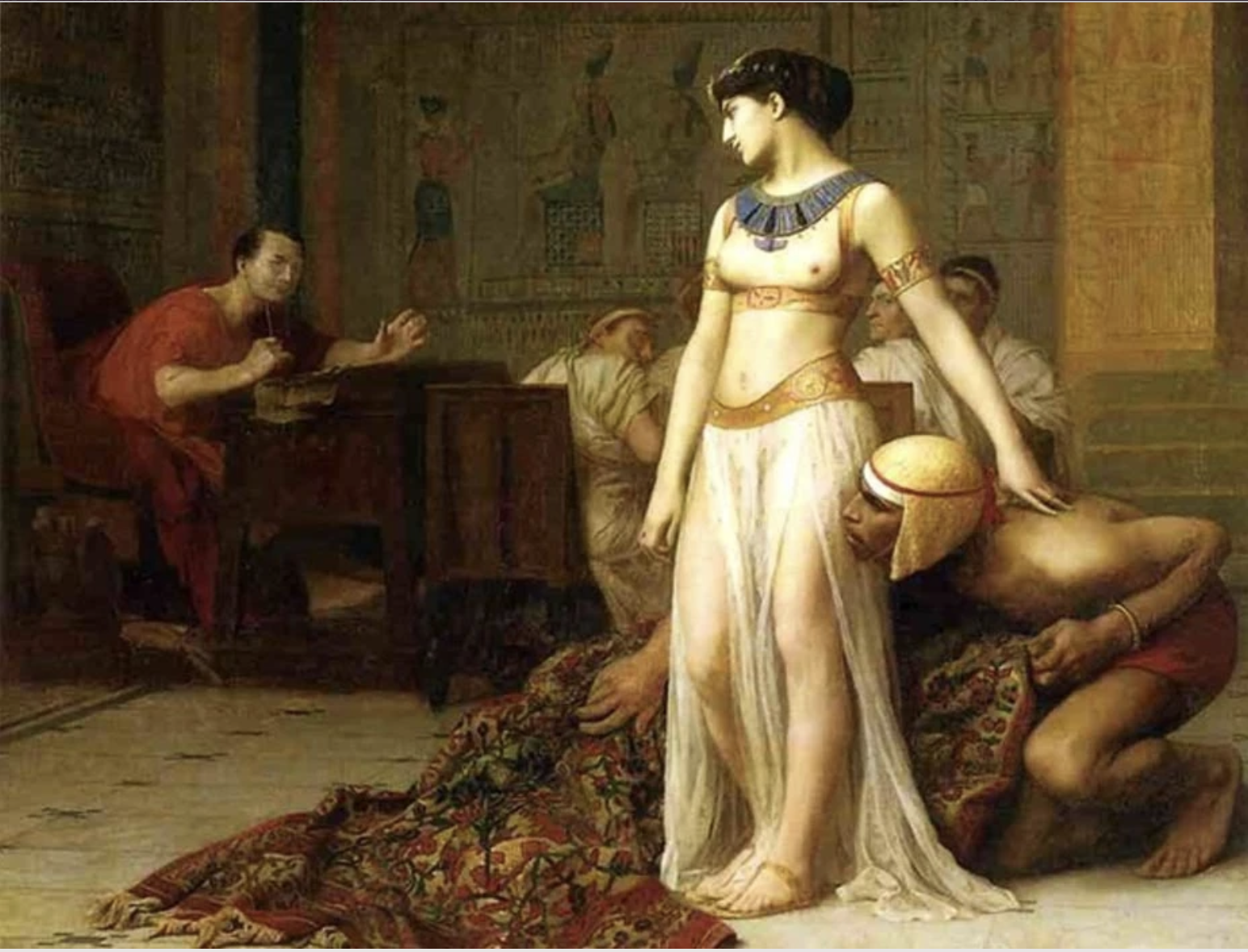
Public Domain.
Her presence in Rome between 46–44 BCE, her participation in Caesar’s triumphal celebrations, and the presentation of Caesarion as their joint son carried a deeply political significance. Cleopatra sought not only to legitimize her rule but also to present Caesarion as a potential heir—not only to the Egyptian throne, but possibly to Rome itself. Such a suggestion was unacceptable to the senatorial elite, indirectly leading to the conspiracy and assassination of Caesar in 44 BCE.
A Woman of Power in a Male-Dominated World
Cleopatra was a woman profoundly aware of the mechanisms of power and how to leverage both her position as queen and her personal relationships in a world where women rarely played an independent role in international politics. Compared with other great women of Egypt, such as Hatshepsut or the Kushite queens of Nubia, Cleopatra stood out not only for her diplomatic skill but also for her ability to exploit Roman weaknesses. Her relationship with Mark Antony, though later interpreted as an example of female “seduction,” was in fact a continuation of a political alliance strategy. When Antony recognized Caesarion as Caesar’s legitimate heir, Octavian used this as a pretext for war, portraying Cleopatra as a threat to Roman order.
The defeat at the Battle of Actium in 31 BCE and Cleopatra’s suicide in 30 BCE marked the end of Egypt’s independence; following its annexation by Octavian Augustus, Egypt became a Roman province.
The Legacy of a Conscious Queen
Cleopatra VII was not the tragic heroine portrayed in later traditions. On the contrary, she was a woman of power who, amid the transformations and political pressures from Rome, skillfully employed every available means to retain the crown and ensure the continuity of the Ptolemaic dynasty. Her decisions were rational, politically calculated, and future-oriented, not merely concerned with personal survival. Caesarion symbolized this hope, which ultimately could not be realized.
The choice of Cleopatra as the subject of this tale is motivated not by her fame or romantic entanglements, but by admiration for a woman who—acting within the constraints of her time—demonstrated that even in a masculinized world it was possible to pursue deliberate, long-term political strategy. Cleopatra VII exemplifies a true leader, dedicating her life to building Egypt’s power. Her talent lay in navigating the mechanisms of authority and brilliantly executing political strategy both within and beyond the borders of the Nile kingdom. By establishing and maintaining stable relations with Rome, she earned the trust and respect of great leaders such as Gaius Julius Caesar. In my view, Cleopatra’s life and actions provide a compelling example of female agency during a pivotal period in the history of the ancient world.
Author: Hanna Tręda – a second-cycle Archaeology student at the University of Warsaw, where under the supervision of Prof. Tomasz Waliszewski. She studies the history of Roman provinces in the Mediterranean region and research on the late antique world. She is passionate about the evolution of architecture and urban planning. Her master’s thesis focuses on the analysis of building materials’ water drainage capabilities, which she connects with climate studies of the 6th century, using sites in Lebanon as case studies.
Editing and translation: A.B.