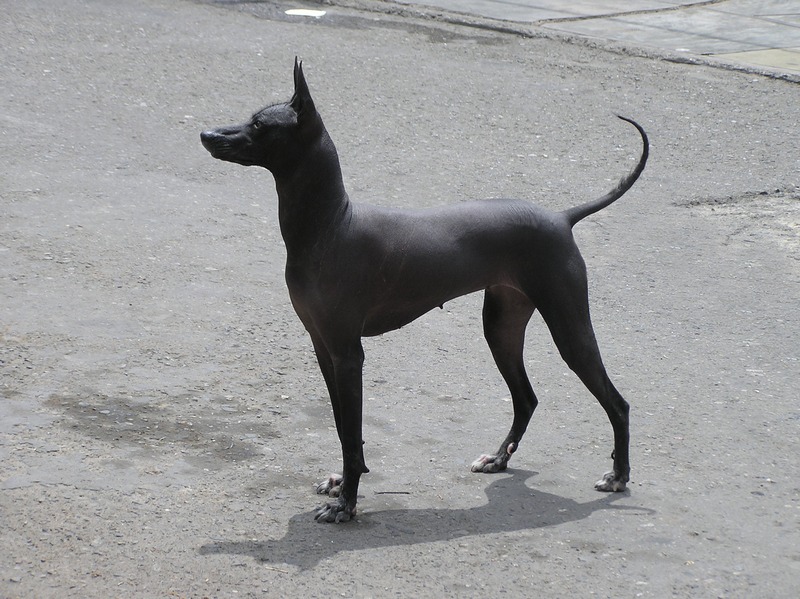
The earliest radiocarbon date obtained so far from Castillo de Huarmey did not come from a monumental tomb, a royal object, or a spectacular architectural feature. It came from a naturally mummified hairless dog. Dated to 688-870 CE, this unusual find is more than a curiosity. It opens a window onto a much larger story: in the Wari world, dogs were not simply pets or strays, but animals with many social lives: helpers, scavengers, companions, and perhaps even guides to the afterlife.
© Hookery, CC BY-SA 3.0
A dog at the beginning of the site’s story
Castillo de Huarmey, on the north coast of Peru, is known as an important ceremonial and funerary center of the Wari Empire, the first large imperial polity of the ancient Andes. Archaeologists have excavated rich elite burials, ceremonial architecture, and remarkable offerings there for years. Yet one of the most surprising discoveries discussed in the newly published paper is a naturally mummified male dog found in an area near the main funerary complex. This individual, identified as hairless, produced the earliest radiocarbon date currently known from the site: 688-870 cal CE. It may aslo represent an early Wari-period example of the Peruvian Hairless Dog.
That makes the animal important not only for the history of dogs in the Andes, but also for the chronology of Castillo de Huarmey itself. The earliest securely dated life at the site is, in this case, tied to a dog.

© Weronika Tomczyk
More than pets
That striking date is only the beginning of the story. The paper argues that dogs at Castillo de Huarmey should not be understood simply as pets. Instead, the authors propose a broader way of thinking about them, using the concept of “companion species.” In this approach, dogs could occupy many roles at once and their relationships with humans were not limited to affection or domestic companionship.
The evidence suggests that Wari dogs had diverse lives. Some may have accompanied camelids and moved with people through the landscape. Some likely lived by scavenging near human activity. Others may have been closely tended, especially during early life. And after death, some seem to have taken on symbolic or ritual roles.

© Tomczyk et al. 2026, Fig. 1, CC BY-NC 4.0
Dogs buried with the dead
One of the strongest parts of the study is the evidence that some dogs were deliberately associated with human burials. The researchers analyzed dog remains excavated between 2010 and 2025 and identified 341 dog bones, representing at least 20 individuals. Among them were puppies and adults found in specific funerary contexts. A puppy was buried with the so-called Master Basketmaker. Another puppy accompanied the male guardian known as “XY.” A partial adult dog skeleton was found with a teenage child in a palatial context.
These were not casual deposits. Such repeated associations suggest dogs held an important place in Wari funerary life. In Andean traditions, dogs are sometimes linked with passage between the worlds of the living and the dead. For that reason, the researchers suggest that some of the dogs from Castillo de Huarmey may have been understood as psychopomps, beings that guide souls into the afterlife.
Some were valued, some were ignored
However not every dog at Castillo de Huarmey was treated in the same way. Zooarchaeological analysis showed very few butchery marks, so dogs do not seem to have been widely eaten at the site. At the same time, not all of them were carefully buried. Some remains appear to have been treated more like refuse, and some animals may simply have lived off the settlement as opportunistic scavengers.
That is one of the paper’s most interesting conclusions: dogs were part of Wari daily life in many different ways, and human attitudes toward them varied. Some may have been closely connected with people. Others were probably tolerated but not especially cared for. This makes the assemblage more complex, and more realistic, than a simple story about “beloved ancient pets.”

© Tomczyk et al. 2026, Fig. 2, CC BY-NC 4.0
The case of the Peruvian Hairless Dog
The research presents evidence for at least three dogs tentatively identified as Peruvian Hairless Dogs. Today this breed is recognized as part of Peru’s cultural heritage, but direct zooarchaeological evidence from Wari sites has been very limited. The identification here rests on several clues, including congenital absence of certain teeth, preserved skin, sparse light-colored hair on the mummified body, and comparison with what is known about the hairless phenotype.
The site also yielded a ceramic vessel depicting an anthropomorphized Peruvian Hairless Dog, which gives this interpretation additional symbolic weight. Together, the biological remains and the iconography suggest that these dogs may have had a special place in the local social and ritual world.
What isotopes revealed about their lives
To go beyond bones alone, the researchers combined zooarchaeology with isotopic analysis. They measured carbon, nitrogen, oxygen, and strontium isotopes from eight dogs. This allowed them to ask what the animals ate, where they probably lived, and whether they moved over long distances.
The results showed that most of the dogs were local to the Huarmey area, but their life histories were not identical. One dog stood out from the others and may have had a diet and mobility pattern different from the rest, perhaps linked to movement with camelids.
Three of the probable hairless dogs turned out to be especially interesting. Their tooth enamel isotopes suggest that when they were young, around 4 to 6 months old, they consumed diets similar to those of human children. Later in life, their diets became more varied. The authors suggest that this may point to special early-life care, and perhaps even to organized breeding practices.

© Tomczyk et al. 2026, Fig. 5, CC BY-NC 4.0
A new way to think about Wari dogs
In the end, the paper’s main contribution is not just that a dog produced the earliest date from Castillo de Huarmey. It presents that dogs in the Wari world had many different kinds of lives. They were not just background animals on the edge of human society. They were woven into everyday routines, mobility, food practices, funerary behavior, and perhaps beliefs about death itself. Ancient dogs were social actors in their own right, entangled with human lives in ways that were practical, symbolic, and sometimes deeply intimate.
This article can be reprinted free of charge, with photos, and with the source indicated
Based on
Volume 82, 2026, 101767, ISSN 0278-4165, https://doi.org/10.1016/j.jaa.2026.101767.
Author: J. M. Chyla
