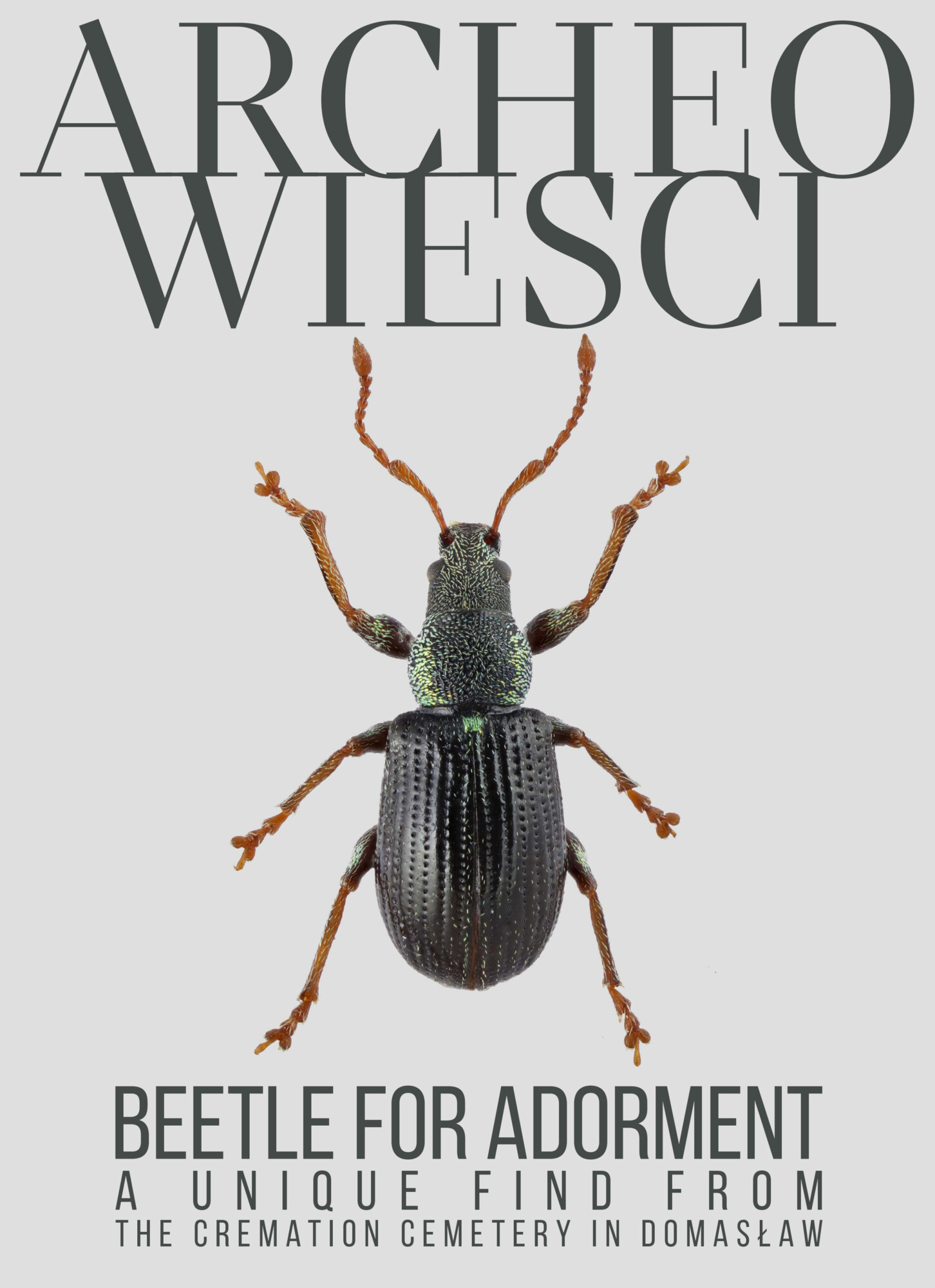
Jewelry made from both organic and inorganic materials is one of the earliest and most popular material evidence of human activity and cultural development discovered at archaeological sites around the world. When we hear the word jewelry, we think of items made from precious metals, gemstones, or shells. But it turns out that past humans made decorations using a surprisingly wide range of materials. During research on burials from the extensive Lusatian culture necropolis in Domasław in Lower Silesia, Polish scientists found evidence of the deliberate deposition of chitinous beetle shells strung on a blade of grass in a grave. This unique discovery sheds new light on the culture of the communities inhabiting Lower Silesia in the early Iron Age.
The Bronze/Iron Age necropolis of Domasław
A cremation cemetery located near the village of Domasław, about 20 kilometers from Wrocław, was first discovered by German archaeologists in the 1920s. However, these initial excavations did not capture the spatial scale and significance of the site.
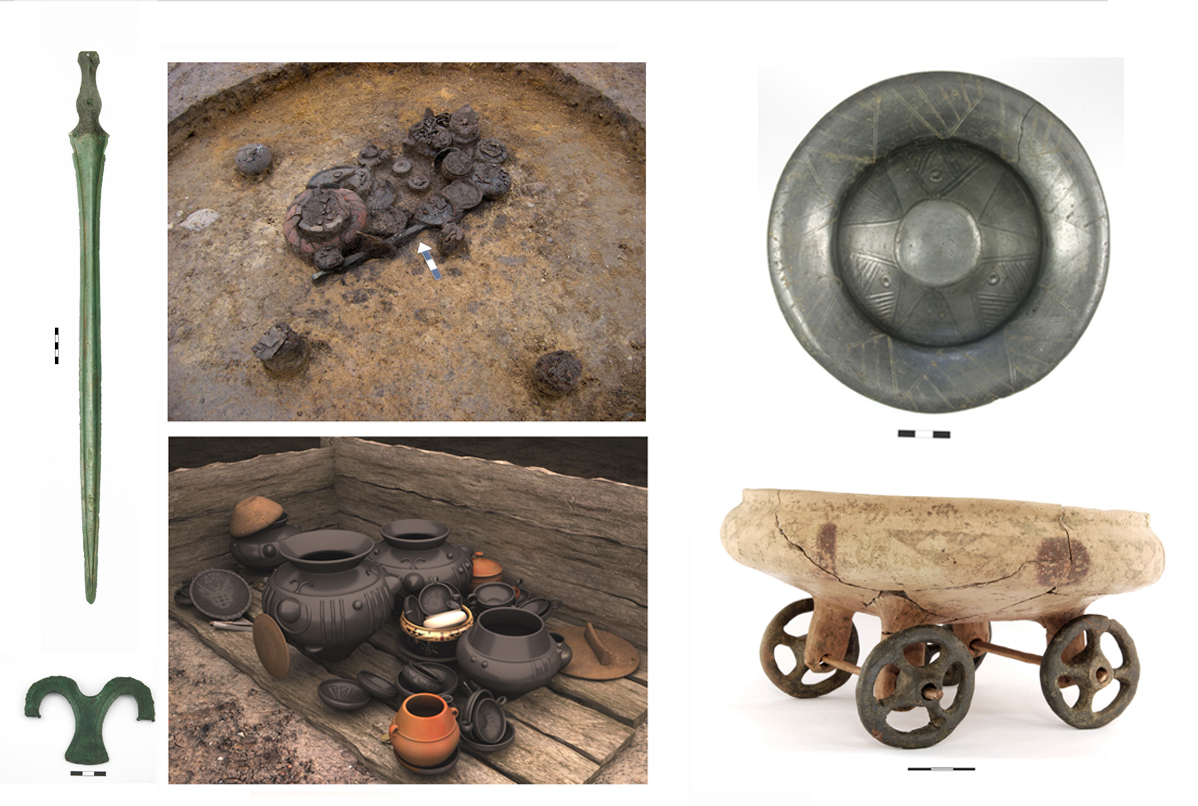
© Archives of the Institute of Archaeology and Ethnology of the Polish Academy of Sciences, visualization: Małgorzata Markiewicz, Institute of Archaeology and Ethnology of the Polish Academy of Sciences
Between 2006 and 2008, archaeologists from the Wrocław branch of the Institute of Archaeology and Ethnology of the Polish Academy of Sciences, led by Professor Bogusław Gediga, conducted extensive research prior to the construction of the Wrocław highway bypass. At the Domasław 10/11/12 site, over 15,000 objects dating from the Neolithic to the Middle Ages were discovered. The most spectacular phase of settlement is associated with the cremation cemetery of the Lusatian culture from the Bronze Age and early Iron Age.
The necropolis functioned from the D period of the Bronze Age (ca. 1300–1250 BC) to the Hallstatt period D and, according to current findings, ceased to be permanently used in the middle of the 6th century BC. At that time, Domasław should be considered an important hub of long-distance contacts in Central Europe. In the Hallstatt phase, numerous imports and imitation products appear in the graves, indicating intensive relations with the Hallstatt circle and the Mediterranean area.
Grave 543
During the excavations, nearly 2,500 sepulchral objects from the Bronze Age and Early Iron Age were discovered, including over 2,000 cremation graves. About 800 of them date back to the Hallstatt period, when the dead were buried on a large scale in richly furnished chamber tombs. Grave 543 belongs to this group, dating back to the later phase of the necropolis and being one of the most impressive.
This grave, located in the south-eastern part of the cemetery, had a boarded pit measuring 4.14 × 3.78 m and nearly 2 m deep (the deepest at the site), with a wooden log chamber with a square plan and walls 1.27 m long.
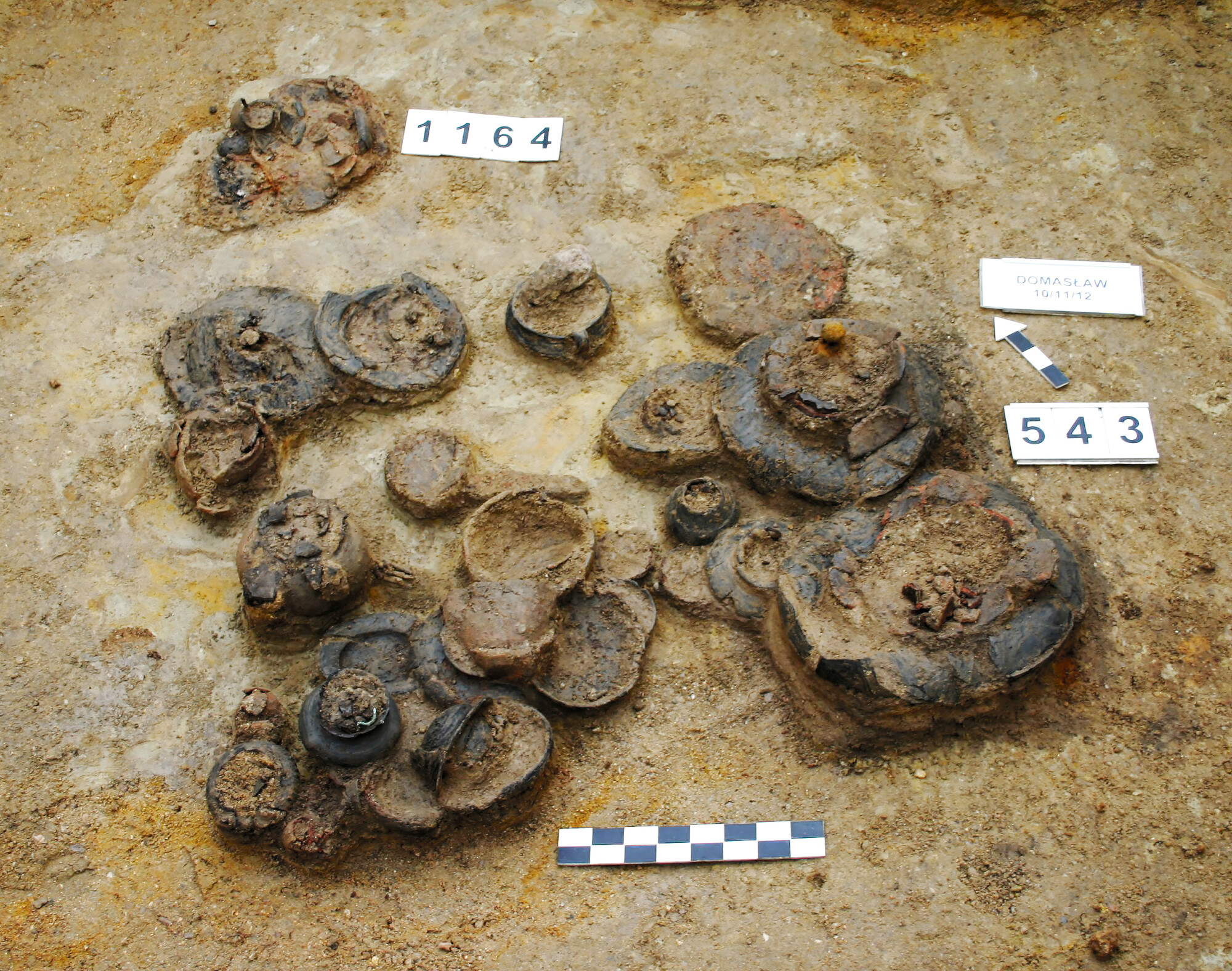
© Archives of the Institute of Archaeology and Ethnology, Polish Academy of Sciences
Bioarchaeological analysis of the burnt bones indicated that the remains of two deceased individuals were deposited here: a child (9–10 years old) and an adult (20–35 years old); the child’s urn also contained the remains of a sheep/goat burnt at the pyre. Despite its conformity with the funeral pattern of the necropolis, grave 543 stands out due to its size, the preservation of numerous organic elements and, in part, its unusual furnishings. These included a belt with a bronze buckle, metal pins, a toilet suit, axes and other tools, and amber beads. In addition, a fragment of antlers, remnants of two different fabrics, wool and delicate linen, probably a container with a lid and bottom made of birch bark and woven walls, as well as a bronze clasp with elements of chitinous beetle shells attached to it, were discovered in the urn with the child’s remains. The delicate ecofacts survived thanks to the patina deposited on the surface of the brooch. Entomological studies revealed a total of 17 pronotums of green longhorn beetles (Phyllobius viridicollis), strung on a blade of grass, although there were originally more of them. They could have been placed on a container, attached to the clasp’s shield or fabric, woven into a braid, or been part of a necklace given to a child. They were certainly an element of clothing or a grave gift with a protective and ritual function – closer to an amulet than decorative jewelry as we understand it today.
Although there are no analogies of intentionally placing insects in graves in the prehistory of Europe, these practices are attested in other traditions and eras. In ancient Egypt, scarabs played a particularly important role, associated with the cycle of life, transformation, rebirth, and the journey of the sun. In Han China (206 BC–220 AD), jade cicadas were placed in the mouths of the deceased, whose spectacular metamorphosis symbolized transformation, rebirth, and protection of the spirit. In the Roman world, insects were also attributed apotropaic significance: amulets made of beetles – especially stag beetles (Lucanus cervus) – were considered talismans protecting against evil forces and diseases, as mentioned, among others, by Pliny the Elder.
In later periods, ethnographic accounts of the Hutsuls – a Slavic ethnic group inhabiting the borderlands of western Ukraine and northern Romania – provide valuable evidence of the making and wearing of insect jewelry. Necklaces composed of about 80 beetles were described, which girls wore as talismans of good luck; both their apotropaic significance and decorative qualities resulting from the natural shine and durability of chitinous shells were valued. In Victorian Britain (1837–1901), beetle wing covers became a widely used decorative material in jewelry and costume elements, combining exotic aesthetics with modern setting techniques.
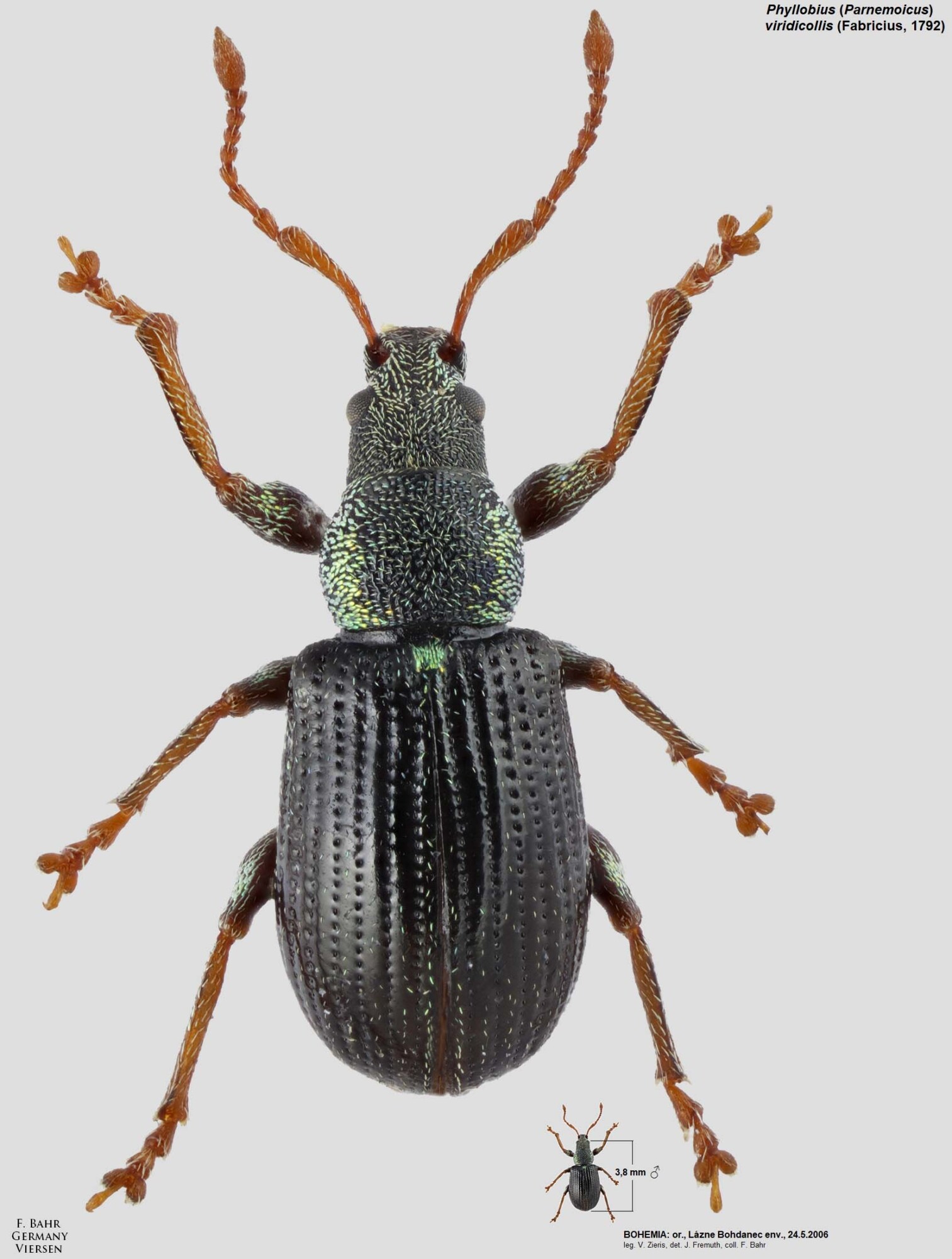
© F. Bahr, licensed under CC BY-SA 3.0
Due to the fragility of chitinous shells, such insect elements quickly degrade. Their presence in archaeological material is extremely rare, which makes the ornament from Domasław a unique find and a testament to how many traces of ancient crafts and practices escape our recognition completely.
The beetles were first identified by Professor Romuald Kosina, for which we are very grateful.
More in the article: Hałuszko A, Kadej M, Józefowska A. Beetle body parts as a funerary element in a cremation grave from the Hallstatt cemetery in Domasław, south-west Poland. Antiquity. Published online 2025:1-9. doi:10.15184/aqy.2025.10182
Author: Anna Józefowska-Domańska – archaeologist at the Institute of Archaeology and Ethnology of the Polish Academy of Sciences. She specializes in the Iron Age, especially funeral rites, the functionality of vessels, and interdisciplinary funeral research.
Editing and translation: A.B.